deal iconMassive Summer Offer: Limited-Time Discount - Flat upto 20% offer on all plans
Coworking vs Traditional Office: Costs & Benefits

Coworking vs Traditional Office: Key Differences, Costs & Benefits

There’s the classic route, sign a lease, set up your own office, done. And then there’s the newer route that’s basically taken over the conversation lately, coworking. Both get the job done in the sense that people show up and get work finished, but the way you get there, and what it actually costs you along the way, looks pretty different.

This comparison, coworking vs traditional office, comes up constantly with founders, HR folks, even solo consultants trying to figure out where to base themselves. So let’s actually break it down properly instead of just throwing buzzwords around.

What Is a Traditional Office Setup?

A traditional office is exactly what it sounds like. You find a space, sign a lease, usually for a few years, and then build it out from scratch. Furniture, internet, AC, security, all of it’s on you to set up and maintain.

It’s the version most of us grew up thinking of as “an office.” Fixed desks. Fixed floor. Your logo on the door, maybe. Full control over how the place looks and feels, down to the paint color if you really want to go there.

But that control comes with a catch. You’re locked into the lease term whether business is booming or barely limping along. You’re also on the hook for every single operational headache, the broken AC, the wifi that keeps dropping, the security guard who didn’t show up today. None of that is somebody else’s problem to fix. It’s yours.

What Is a Coworking Space?

A coworking space flips that whole model. Instead of building and running your own office, you basically rent access to a shared, fully managed workspace alongside other businesses and individuals doing the same thing.

Desks, cabins, meeting rooms, all of it’s already built out and ready. You show up, plug in, and work. No furniture shopping, no negotiating an AMC contract for the air conditioning, no chasing anyone about a broken printer at 9am before a client call.

Most coworking spaces run on flexible plans too, day passes, monthly memberships, hourly meeting room bookings, so you’re not locked into a rigid multi-year commitment just to get a place to sit and work. It’s built for businesses that don’t want to deal with running an office; they just want a good one to walk into.

Key Differences

Here’s where it gets a lot easier to actually compare side by side.

Factor

Traditional Office

Coworking Space

Cost

High upfront deposit, fit-out costs, fixed rent

Lower upfront cost, pay for what you use

Contract Terms

Multi-year lease, hard to exit early

Monthly or flexible, easy to scale or exit

Amenities

You source and manage everything yourself

Bundled in, internet, AC, security, pantry

Scalability

Slow, needs lease renegotiation to grow or shrink

Fast, add or drop desks as needed

Maintenance

Your responsibility entirely

Handled by the space operator

Looking at it laid out like that, it’s not hard to see why so many businesses have started leaning toward coworking, especially ones that don’t want facilities management eating into their actual work.

Cost Breakdown: Coworking vs Traditional Office

Let’s actually talk numbers, or at least the shape of them, since exact figures vary a lot by city and space.

A traditional office usually asks for a security deposit worth several months of rent upfront, sometimes six to ten months’ worth, sitting there before you’ve even moved a chair in. Add fit-out costs on top- furniture, electrical work, interiors- and you’re looking at a serious chunk of capital gone before day one of actually working from the place.

Then there’s the monthly stuff. Rent, obviously, but also electricity, internet, housekeeping staff, security, maintenance contracts for the AC and the lift, and probably a few surprise repair bills you didn’t budget for. None of that shows up on the lease document, but all of it shows up on your books eventually.

Coworking space costs work pretty differently. You’re usually paying a flat monthly or daily rate per desk or per cabin, and that rate already includes internet, AC, housekeeping, security, sometimes even meeting room credits. No separate vendor bills to track down, no AMC renewals to remember, no surprise electrician visit eating into your Tuesday afternoon.

For a small team, this usually works out cheaper on a per-seat basis, once you actually add up everything a traditional setup requires versus one flat number a coworking plan gives you. For bigger teams that stay in one place for years, a traditional office space can eventually work out cheaper per square foot, but that math only holds if the team size and needs actually stay predictable that whole time, which, let’s be honest, isn’t always how business goes.

Benefits of Coworking Over Traditional Offices

There’s a reason this shift has picked up so much momentum, and it’s not just hype.

Lower financial risk is a big one. No massive upfront deposit, no multi-year lease hanging over your head if things don’t go the way you planned. You’re not locked into paying for a floor you might outgrow, or worse, barely use.

Flexibility is probably the single biggest draw, though. Need to add five desks next month? Done, usually within days, not after weeks of lease renegotiation. Need to scale down after a rough quarter? Also doable, without the guilt of paying for empty space you’re stuck with regardless.

Amenities being bundled in genuinely saves a lot of mental overhead too. Not having to think about who’s fixing the AC, or whether the wifi router needs replacing, frees up time and headspace for stuff that actually matters to the business.

There’s a community angle worth mentioning as well. A lot of the benefits of coworking spaces come from just being around other businesses and professionals, occasional networking, a bit of energy in the room that a quiet, empty traditional office just doesn’t really have, especially if your team’s on a hybrid schedule and half the desks are empty most days anyway.

And honestly, the professional image factor matters more than people expect. Walking a client into a well-designed, well-maintained coworking space often looks a lot more polished than a half-furnished office you’re still setting up six months after signing the lease.

When Traditional Offices Still Make Sense

None of this means coworking wins in every single situation. Traditional offices genuinely still make sense for certain businesses, and it’s worth being honest about that instead of pretending one option fits everyone.

Large, stable enterprises with predictable headcount over many years often do better financially with a traditional lease, especially once they’re big enough to negotiate favorable terms and the space is genuinely getting used at full capacity, not sitting half empty.

Businesses that need heavy customization, specialized labs, manufacturing setups, industry-specific infrastructure that a shared space simply can’t accommodate, don’t really have a coworking option to begin with. That’s just the nature of what they do.

And companies deeply invested in a very specific brand identity, wanting every visual detail of the office to reflect their culture exactly, might find a traditional office gives them more room to actually build that out fully, rather than working within whatever design a coworking operator has already settled on.

So it’s less about one option being universally better, and more about which one actually fits your business’s size, stability and specific needs at this point in time.

Conclusion

At the end of the day, coworking vs traditional office isn’t really a competition with one clear winner. It’s a question of what your business actually needs right now. If you value flexibility, lower upfront risk, and not having to deal with facilities management, coworking is probably the smarter call. If you’re a large, stable operation with predictable needs stretching years out, a traditional office might still make more sense for you.

Not sure which fits your situation? Book a tour of a coworking space near you and see how it actually feels to walk in and just start working, no lease negotiations, no furniture shopping, no waiting around.

FAQs

Is coworking cheaper than a traditional office? Usually, yes, for smaller teams especially. Coworking bundles internet, AC, housekeeping and security into one flat rate, while a traditional office requires you to set up and pay for all of that separately on top of rent.

What’s the biggest difference between coworking and a traditional office? Flexibility. Coworking spaces let you scale up or down with short-term plans, while traditional offices lock you into a multi-year lease regardless of how your team size changes.

Do coworking spaces offer private space for teams? Yes. Most coworking spaces offer private cabins alongside open desks, so teams can get a closed, dedicated space without needing an entire traditional office to themselves.

Which is better for a growing startup, coworking or a traditional office? Coworking generally works better for growing startups since headcount and needs change fast, and a flexible setup avoids the risk of being locked into space that no longer fits a few months down the line.

Can large companies use coworking spaces too? Yes, many do, especially for satellite offices, project teams, or testing a new city before committing to a permanent traditional office there.
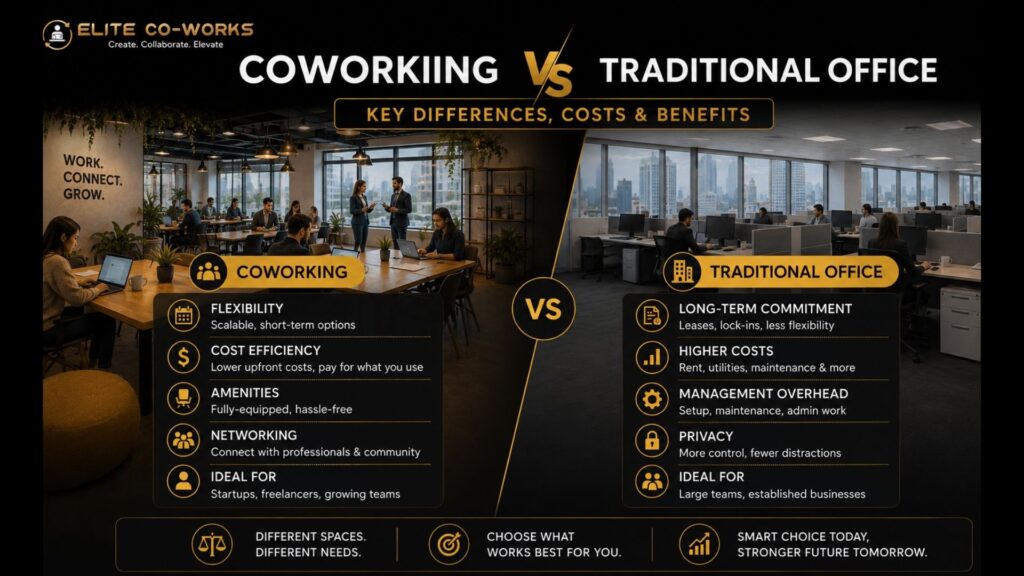


Table of Contents

Modern, Affordable & Flexible Co-Working Space @ BTM Layout, Bengaluru.

Workspace starts @ INR 5000*/month

Recently Posted

Modern, Affordable & Flexible Co-Working Space @ BTM Layout, Bengaluru.

Workspace starts @ INR 5000*/month